The review platform landscape for real estate agents has consolidated meaningfully since the late 2010s. Five years ago, agents worried about maintaining presence across Google, Yelp, Facebook, Zillow, Realtor.com, Trulia, and a half-dozen smaller industry-specific sites. In 2026, the practical landscape is much simpler: three platforms drive nearly all of the prospect research that translates into new client inquiries, with the rest contributing marginal value at best.
This guide is the practical reference for which platforms actually matter, how reviews work on each, where to invest your review collection energy, and how to think about the structural differences between agent-level review profiles (yours personally) and brokerage-level review profiles (your firm's). The latter distinction has become significantly more important as both Zillow and Google have evolved their algorithms and as multi-agent brokerages have started building deliberate review programs across both levels.
If you're an individual real estate agent looking for the operational deep-dive on how to actually collect reviews across these platforms — when in the transaction to ask, what to say, how to handle the sphere-of-influence dynamics — see our companion post on Google reviews for real estate agents. For brokerage owners and managing brokers coordinating reviews across a team of agents, see our multi-agent agency review post. This post focuses on the platform landscape itself — which sites matter, how each one works in 2026, and where to invest your effort.
Three structural shifts shape the 2026 review platform landscape for real estate:
Zillow absorbed Trulia. Zillow Group acquired Trulia in 2015. For years afterward, the two platforms maintained somewhat separate identities, but the agent review systems have effectively consolidated. Trulia agent profiles in 2026 are part of the Zillow ecosystem — a review left on what was historically Trulia flows into the agent's Zillow review base. Treating Trulia as a separate platform to maintain is largely an artifact of older marketing playbooks.
Google's local 3-pack became dominant for "agent near me" search. Five years ago, prospects researching real estate agents commonly started on Zillow or Realtor.com and used the platforms' internal directories. In 2026, the dominant prospect journey starts on Google with searches like "real estate agent [city]" or "best realtor [neighborhood]," and the local 3-pack on Google determines who gets the first click. Reviews on Google specifically drive this 3-pack ranking — which means Google has overtaken the platform-specific directories as the most important review surface for new-client acquisition.
Yelp and Facebook lost relevance for real estate specifically. Both platforms still exist, both still accept reviews, and an agent should still maintain a clean profile on each. But the share of new clients who research real estate agents via Yelp or Facebook (as opposed to Google or Zillow) has fallen meaningfully. Investing heavy effort in Yelp reviews for real estate produces poor returns compared to investing the same effort in Google or Zillow.
Industry-specific aggregator sites haven't displaced the big three. Sites like Homesnap, HomeLight, and similar directories have built review systems, but none have reached the scale where they meaningfully drive new-client acquisition for most agents. They're worth a one-time setup and forget; they don't deserve ongoing review-collection focus.
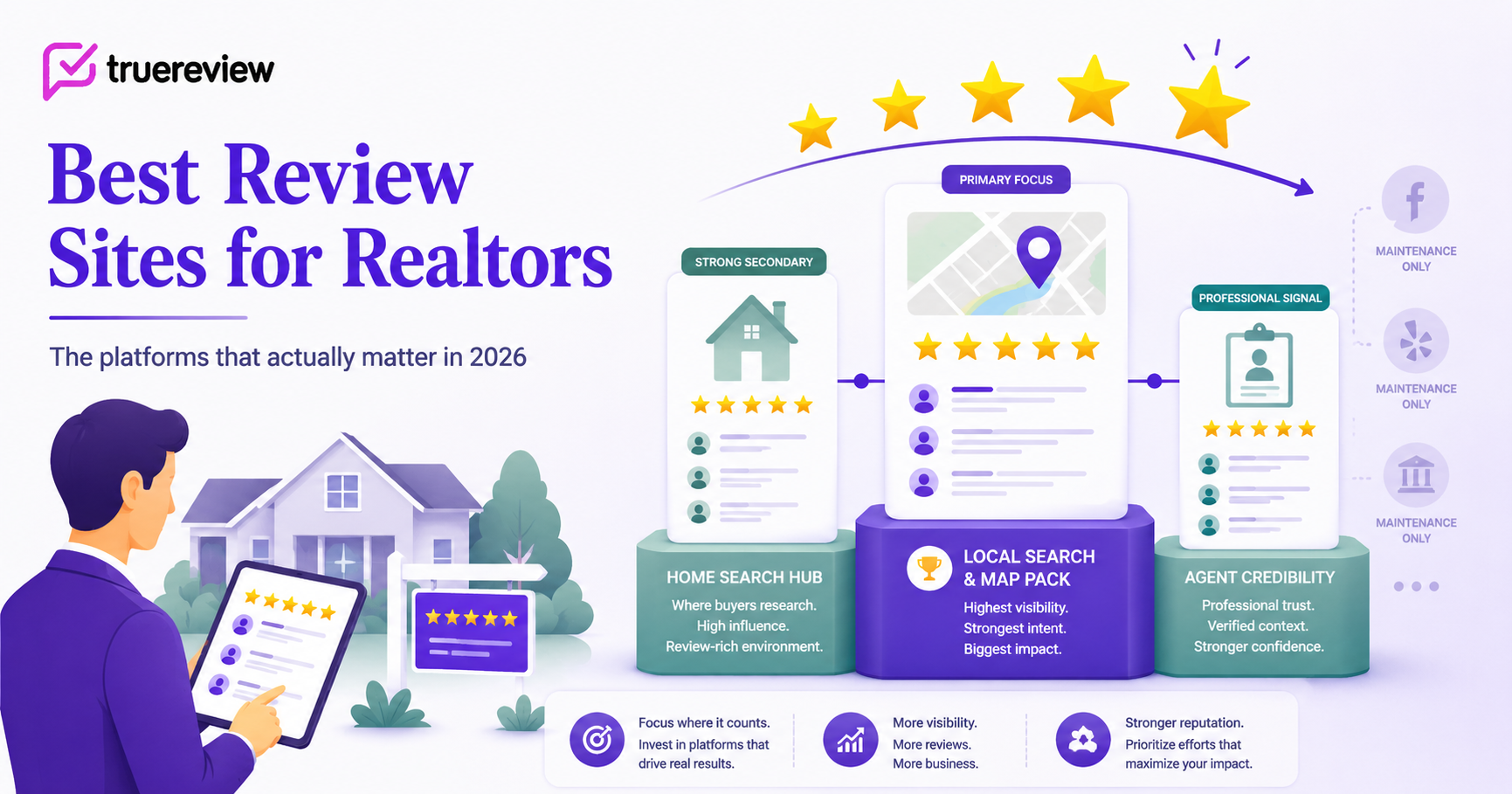
The combined result: agents and brokerages in 2026 should concentrate review collection energy on three platforms — Google, Zillow, and Realtor.com — with light maintenance of presence elsewhere. The platform-specific mechanics of each matter enough that they deserve dedicated treatment.
Google has become the single most important review platform for real estate agents and brokerages. Three dynamics drive this:
Local search dominance. Prospects researching real estate agents typically Google their need — "real estate agent [city]," "best realtor [neighborhood]," "buyer's agent [zip]," "listing agent [area]." Google's local 3-pack appears at the top of these results, showing three local businesses with map placement. Reviews are a primary signal determining which agents appear in the 3-pack.
Geographic relevance. Google's local algorithm weights geographic proximity heavily for real estate searches. An agent serving Brooklyn benefits from Google reviews mentioning Brooklyn neighborhoods. The keyword content of reviews — service types, neighborhoods served, transaction types — feeds into the relevance signals Google uses for ranking.
Trust signaling for referred prospects. Even prospects who arrive via referral (their friend recommended you) typically Google your name before committing to a meeting. Your Google review profile is the first impression they form. A thin profile loses some referred prospects who hesitate after their research; a strong profile validates the referral and accelerates conversion.
How reviews work on Google for real estate:
Practical investment level: Google should receive the most attention of any platform. Aim for sustained monthly review velocity, systematic response to every review within 24-48 hours, and embedded review widgets on your website pulling from your Google Business Profile. For the operational specifics, see the companion deep-dive post.
Zillow remains the dominant platform-specific destination for active home buyers and sellers researching agents. The platform's role isn't to drive search-engine discovery (Google does that better) but to be where actively shopping prospects land during the research phase of their transaction.
The customer journey on Zillow: A buyer browsing for homes on Zillow's listings inevitably encounters agent profiles — the listing agent on a property they're interested in, the buyer's agent on listings they're scheduling tours for, agents that show up in Zillow's "Find an Agent" directory. Reviews on these profiles directly influence whether the prospect requests information or moves on to a different agent's listings.
How reviews work on Zillow:
Practical investment level: Zillow deserves the second-most attention after Google. The buyer-research-phase prospect journey on Zillow is unusually high-intent — a prospect reading agent reviews on Zillow is typically weeks away from a transaction decision, which makes review quality decisive. Develop a deliberate process for collecting Zillow reviews from past clients alongside your Google review collection.
One specific consideration: Zillow agent reviews are tied to agents, not brokerages. If you switch brokerages, your Zillow review base stays with you. This is the opposite of how it works for brokerage-level Google profiles. Plan accordingly for your personal brand.
Realtor.com is operated by Move, Inc. (a subsidiary of News Corp) under a marketing agreement with the National Association of Realtors. The platform draws meaningful traffic from prospects who specifically search for NAR-affiliated agents and benefits from the consumer recognition of the "Realtor" brand.
The customer journey on Realtor.com: Similar to Zillow but smaller in scale. Prospects browsing listings encounter agent profiles, and the agent's review profile influences whether they request a showing or contact the agent.
How reviews work on Realtor.com:
Practical investment level: Worth maintaining presence on Realtor.com, but lower priority than Google or Zillow. The user base is smaller, the prospect-conversion impact per review is modest, and the operational mechanics are similar enough to Zillow that consistent collection across both is easier than treating them as completely separate platforms.
For most agents, the optimal approach is: maintain a complete, professional Realtor.com profile, ensure existing reviews are responded to, and periodically (perhaps quarterly) ask satisfied clients to leave a Realtor.com review specifically — but don't treat Realtor.com as a primary investment.
Facebook business pages still accept "recommendations" (the platform's version of reviews) and these recommendations appear publicly on the page. For real estate agents, Facebook serves a real but limited role.
Where Facebook recommendations matter:
Where Facebook recommendations don't matter much:
Practical investment level: Maintain a professional Facebook business page, respond to existing recommendations, but don't make Facebook recommendation collection a primary review program component. The time-per-review return is much better on Google and Zillow.
Yelp has the smallest realistic role of the major review platforms for real estate agents. Real estate searches make up a small share of Yelp activity compared to restaurants, salons, and similar categories that drove Yelp's growth. Some prospects do check Yelp for agent reviews, but the share is too small to justify substantial investment.
Practical investment level: Maintain a clean Yelp business page if you have one, respond to any reviews that appear, but don't proactively solicit Yelp reviews from past clients. The opportunity cost — that ask "spent" on Yelp could have been a Google or Zillow review — is real.
One specific exception: agents in restaurant-and-hospitality-heavy urban markets (San Francisco, NYC, Los Angeles core) where Yelp is genuinely culturally relevant. Even there, the prospect-conversion math doesn't strongly justify intensive Yelp review collection compared to other platforms.
A handful of real-estate-specific review and aggregator sites operate alongside the major platforms. Most warrant a one-time profile setup and ongoing low-touch monitoring rather than active review collection.
Practical investment level: Set up complete profiles where reasonable. Monitor periodically. Don't make these part of your active review collection program.
One of the most important strategic decisions for real estate professionals isn't which platform to focus on — it's how to think about agent-level vs. brokerage-level review profiles.
Agent-level review profiles are tied to you personally. Your Zillow reviews stay with you if you switch brokerages. Your Realtor.com reviews stay with you. Your personal Google Business Profile (if you've claimed one) stays with you. These reviews build your personal brand and follow your career.
Brokerage-level review profiles are tied to the firm. Your brokerage's Google Business Profile, its Yelp page, its Facebook recommendations — these belong to the brokerage. If you leave, those reviews stay with the brokerage.
For individual agents: Invest primarily in your personal review profile (Google personal profile, Zillow, Realtor.com). These build your portable personal brand. Maintain professional presence on your brokerage's profile but recognize that those reviews build the brokerage's reputation, not yours.
For brokerage owners and managing brokers: The decision is more nuanced. Strong individual-agent profiles help recruit and retain top producers (whose personal review portfolios become recruiting assets). Strong brokerage profiles help recruit newer agents who benefit from brokerage brand equity. Most successful brokerages invest deliberately in both levels. See our multi-agent agency review post for the brokerage-level strategy in depth.
The agents and brokerages that systematically think about this distinction — and invest accordingly — end up with sustainable competitive positions that thinner-thinking competitors can't match.
A common mistake: agents try to maintain "presence everywhere" and end up with thin, inconsistent profiles across many platforms. The better approach is concentrated investment in the platforms that actually matter, with appropriate timing and operational rhythm.
Tier 1 (primary investment): Google. Aim for systematic monthly review velocity. Set up automated SMS or email workflows to request reviews after every closed transaction. Respond to every review within 24-48 hours.
Tier 2 (secondary investment): Zillow. Ask satisfied clients to leave Zillow reviews specifically when they're in the Zillow ecosystem already (e.g., the client found you through Zillow originally). Maintain a complete, professional Zillow profile. Respond to reviews.
Tier 3 (tertiary investment): Realtor.com. Quarterly ask of selected satisfied clients. Maintain a complete profile. Respond to reviews.
Tier 4 (maintenance only): Facebook, Yelp, industry-specific sites. Maintain professional presence, respond to anything that appears, don't proactively solicit.
The operational reality: most agents won't add multi-platform asks to every closed transaction. The cleaner approach is to alternate. After this closing, ask for a Google review. After the next, ask for Zillow. Every few months, ask a particularly happy client to leave a Realtor.com review. Sustained light pressure across platforms beats burst activity on any single one.
For the SMS and email templates that actually work for these requests, see our post on Google and Zillow reviews for real estate agents. For coordinating these workflows across a team, see the multi-agent agency post.
The 2026 review platform landscape for real estate agents is simpler than it was five years ago. Three platforms — Google, Zillow, and Realtor.com — handle nearly all of the prospect research that translates into new client inquiries. The rest are worth maintaining presence on but don't deserve active review collection focus.
A real estate professional with a sustainable multi-platform review program in 2026 has:
The compounding effect over 18-24 months produces sustainable competitive positioning that thinner-investment competitors can't match. New-client inquiries flow more consistently. Listing presentations land more confidently. Referrals validate faster.
For the operational deep-dives on actually executing this — when to ask, what to say, how to handle the sphere-of-influence dynamics, how to coordinate at the brokerage level — see our companion posts on Google and Zillow reviews for real estate agents and multi-agent brokerage review strategy.
Ready to build a multi-platform review program for your real estate business? Start your free 14-day trial of TrueReview — automated review request workflows for Google, Zillow, and Realtor.com timed to your transaction milestones; integration with LionDesk and most real estate CRMs via Zapier or direct connection; per-agent dashboards for multi-agent brokerages with the Manage Multiple Businesses feature; embeddable review widgets that pull from Google for your agent website or brokerage site; and unified multi-platform monitoring across Google, Zillow, Realtor.com, Facebook, Yelp, and other platforms so you can respond to every review consistently without checking each platform manually. No setup fees, no contracts.


 Watch Free Demo